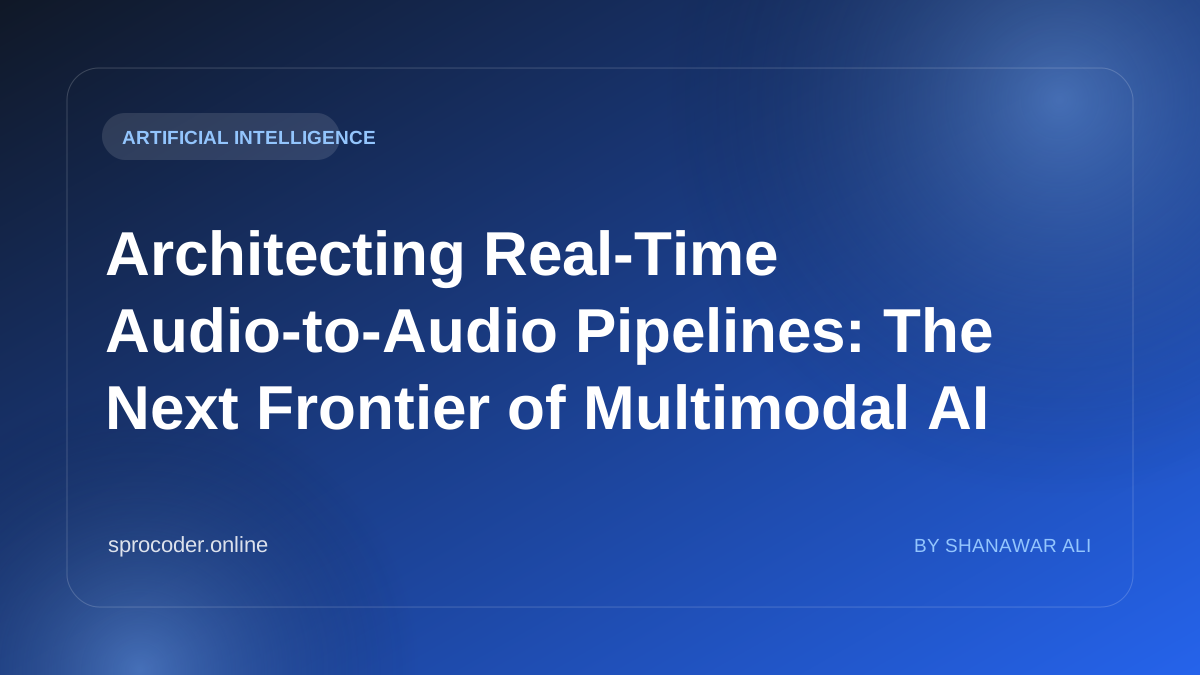
The Death of the Cascaded Voice Stack
For years, voice-enabled [artificial intelligence] was a cobbled-together illusion. If you interacted with a voice assistant, your audio was routed through a three-stage cascaded pipeline: Automatic Speech Recognition (ASR) to convert audio to text, a Large Language Model (LLM) to process the text and generate a text response, and finally, a Text-to-Speech (TTS) engine to synthesize the final output.
While functional, this legacy system had massive architectural drawbacks. First, the [latency budget] was terrible. Summing the execution times of three distinct deep learning models, plus serialization and deserialization overhead, made sub-500 millisecond response times impossible. Second, it stripped away rich contextual metadata. In a cascaded stack, the emotional nuance, sarcasm, pitch, hesitation, and background acoustics of the speaker are completely lost in translation once converted to raw text.
In 2026, the paradigm has shifted entirely. We have entered the era of native [audio-to-audio] neural architectures. By feeding continuous audio streams directly into unified multimodal neural networks, state-of-the-art models now achieve true duplex, real-time voice interactions with sub-150ms latencies, preserving prosody, tone, emotion, and ambient context natively.
The Architecture of Native Audio-to-Audio Pipelines
To understand how modern [multimodal LLMs] process speech natively, we must look at how they represent sound. Unlike text, which is easily tokenized into discrete words or sub-words, raw audio is a continuous high-frequency waveform. Running a 44.1kHz audio signal directly into a Transformer sequence-by-sequence is computationally infeasible due to the quadratic complexity of self-attention.
To solve this, advanced pipelines use [neural audio codecs] paired with [vector quantization]. These codecs compress high-dimensional continuous audio into a discrete bottleneck of codebook indices. The most popular architectures utilize Residual Vector Quantization (RVQ), where an audio frame is represented as a matrix of hierarchical codes. The top layer captures coarse acoustic features (phonemes, pitch), while subsequent layers reconstruct fine-grained details (timbre, environmental texture).
Once tokenized, these audio tokens are mapped directly into the same latent space as text tokens. The multimodal model is trained on combined sequence inputs, treating text and audio as interchangeable modalities. This allows a single, unified Transformer to predict next-audio-tokens directly from prefix-audio-tokens without intermediate text translation.
Overcoming the Duplex and Interruption Problem
In real-world conversation, human speech is not half-duplex. We do not wait for a clean 'stop' token before we formulate a response. We laugh mid-sentence, grunt in agreement, or interrupt when we need clarification. Implementing this in an [audio-to-audio pipeline] requires sophisticated streaming mechanisms and custom inference configurations.
Modern systems solve this by establishing continuous, bidirectional WebSockets or WebRTC data channels to the inference server. The neural engine maintains two active states:
The Listening State: The model constantly processes incoming audio packets, updating its internal context vector.
The Generation State: The model streams tokenized audio packets back to the client.
When the client starts speaking during a model generation phase, a low-latency [interruption detection] heuristic instantly triggers. This forces the model to halt token generation, clear its current generation buffer, append the client's new input audio to the conversation history, and recalibrate its attention weights. Achieving this without introducing jarring audio artifacts requires precise control over token-generation intervals.
Implementing a Real-Time Audio-to-Audio Connection
To demonstrate how developers interact with modern multimodal voice models, the following Python script showcases a real-time, low-latency audio stream orchestration using an asynchronous WebSocket connection. This technical blueprint demonstrates session initialization, modality selection, and continuous audio transmission to an advanced [generative AI] audio server.
import asyncio
import websockets
import json
import sys
Configuration for a real-time multimodal audio-to-audio session
API_URL = "wss://api.neural-multimodal.example/v2/realtime/voice-session" API_KEY = "sk_prod_audio_928374982347"async def stream_audio_session():
headers = {
"Authorization": f"Bearer {API_KEY}"
}
try:
async with websockets.connect(API_URL, extra_headers=headers) as ws:
print("[*] Connected to Multimodal Real-time API.")
# Step 1: Send Session Initialization Configuration
session_config = {
"type": "session.configure",
"config": {
"model": "omni-audio-v3",
"modalities": ["audio"],
"audio_format": "pcm_24khz_16bit",
"voice_profile": "empathic_conversational_05",
"latency_mode": "ultra_low",
"interruption_threshold_db": -35.0
}
}
await ws.send(json.dumps(session_config))
print("[*] Session configured. Model set to omni-audio-v3.")
# Step 2: Concurrently read from microphone and handle model output
async def send_mic_audio():
while True:
# Mock reading continuous 100ms chunks of 24kHz raw PCM audio
# In production, replace with sounddevice or PyAudio buffer stream
mock_audio_chunk = b'\x00\x01' * 2400
audio_payload = {
"type": "input_audio_buffer.append",
"audio": mock_audio_chunk.hex()
}
await ws.send(json.dumps(audio_payload))
await asyncio.sleep(0.1) # Send every 100ms
async def receive_model_response():
async for message in ws:
event = json.loads(message)
event_type = event.get("type")
if event_type == "audio.delta":
# Output incremental audio chunk from model stream
audio_data_hex = event.get("delta")
audio_bytes = bytes.fromhex(audio_data_hex)
sys.stdout.write(f"\r[Streaming Output] Received {len(audio_bytes)} bytes.")
sys.stdout.flush()
# Write output bytes to speaker stream here...
elif event_type == "user.interruption":
print("\n[!] Interruption detected! Clearing playback buffer.")
# Instantly cancel playback and clear client side buffers
# Run both streaming tasks in parallel
await asyncio.gather(send_mic_audio(), receive_model_response())
except Exception as e:
print(f"\n[!] Connection error: {str(e)}")
if __name__ == "__main__":
asyncio.run(stream_audio_session())
The Hardware Bottleneck and Edge Deployment
Running native audio-to-audio models is incredibly demanding on compute resources. In text generation, each token processed equals one word or fractional word. In native audio processing, a single second of audio can yield anywhere from 50 to 100 spatial audio tokens. This dramatically inflates the context window size and places severe strain on the Memory Bandwidth of hosting accelerators.
To combat this, the industry relies on highly parallelized [tensor processing units (TPUs)] and dedicated GPU clusters utilizing FlashAttention-3 optimizations. Additionally, weight-quantization strategies like 4-bit NormalFloat (NF4) have made it possible to shrink these massive multimodal architectures down to sizes that can run locally on edge hardware, including smartphones and dedicated [AI agents] appliances.
Edge execution completely bypasses internet latency, unlocking the Holy Grail of conversational systems: instantaneous, offline, zero-latency interactions that feel as immediate as speaking to another human face-to-face.
Conclusion
We are witnessing the final boundary of natural human-computer interfaces dissolve. The migration from disjointed, slow cascaded systems to unified, end-to-end [audio-to-audio pipelines] represents a monumental leap in how machine intelligence processes our world. By treating speech not as a secondary translation of text, but as a primary, multi-dimensional signal full of richness, emotion, and context, AI can finally understand not just what we say, but exactly how we say it.
Frequently Asked Questions (FAQs)
What is the difference between cascaded voice models and native audio-to-audio models?
Cascaded models chain three separate systems together (ASR, LLM, and TTS), which adds significant latency and strips out non-verbal context. Native audio-to-audio models process continuous sound waves natively, treating audio tokens similarly to text tokens within a single unified Transformer. This eliminates intermediate text steps and preserves emotional tone and environmental acoustics.
How do neural audio codecs convert continuous sound waves into discrete tokens?
They use an encoder-decoder network combined with Residual Vector Quantization (RVQ). The encoder compresses the continuous waveform into lower-dimensional representations, which are then mapped to indices in a discrete codebook. These indices serve as tokens that the multimodal model can process and generate.
How does the model handle user interruptions during speech generation?
In bidirectional real-time setups, an interruption detection mechanism monitors incoming audio. If the user begins speaking while the model is playing output, the pipeline triggers an immediate interruption signal, clearing the output buffer and adjusting the Transformer's attention state to focus on the new input.
Can these real-time audio models run locally on consumer devices?
Yes. While training requires massive GPU clusters, modern inference optimizations—such as weight quantization (e.g., INT4 or NF4 format) and specialized edge NPU hardware—enable compact versions of native voice models to run locally on mobile devices and laptops, minimizing latency and enhancing data privacy.